Showing posts with label Reviews (Archive - War Drama). Show all posts

Saturday, November 14, 2009

Archive Review: Patton (1979) - 4/5 Stars


"Patton" might not be the greatest war movie ever made, but it's without question cinema's finest character study. It's a portrait of a man painted so vividly that I bet -- at least since 1970 -- that there are far more historians whose research emphasis is on Gen. George S. Patton than any other war hero/major military figure. Hollywood has given us any number of unique and enigmatic characters, but none so compelling and quickly gathering of our sympathies as Patton.

Patton was an American general in World War II, but more specifically he was fighter, a soldier a man who believed in war as part of human nature. He was also a poet and a war history romantic. He was prideful, he was vulgar, he was both loved and despised. The list goes on, because that's how incredibly complex Francis Ford Coppola and Edmund H. North's character is as well as the layers of depth George C. Scott gives him.

Scott refused his much-deserved and won Oscar, but he insisted he didn't belong in an elite category. What he didn't really consider was that sometimes an actor, usually a character actor, comes across a role so perfectly suited to their talents, a part that wouldn't be the same done by any other actor, that greatness happens. Scott found that role. Few actors ever do. He plays Patton with such command yet the more Patton realizes his fallibility, Scott withdraws ever so slightly, bringing the character a tad closer to earth each time, but never losing that essence of pride and self confidence.

"Patton" is a long movie and you spend much of it just craving for Patton to do or say something. From his eternally quotable opening monologue before a backdrop of the American flag onward, we can't see or hear enough of the man. He's utterly fascinating. He speaks American war ideals like they're fundamental truths about the universe. Hippies would be ready to die for their country after listening to that, no matter how many swears he uses. And he never appears crazy. In fact, throughout the film as Patton's commanding officers reprimand him for his behavior including hitting a soldier, we find ourselves wondering "why doesn't anyone else see this man's brilliance?" He's not nice, but he's right. The idea of Patton as a war man and not a politician plays out then throughout the rest of the film.

Honestly, whenever Patton's not on screen and specifically saying something, the film is uninteresting. There's one terrific action moment where Scott, angry at the incompetent British in Morocco, goes outside with his pistol and tries to shoot two German planes down. After that, the war scenes are nothing but random explosions and images without any narrative relevance to the story. In a nearly three hour film, it's fair to consider all the scenes where the best part of the film plays little or no role a bit tedious and pointless.

It's impossible to describe in a review the many depths and levels of Patton's character. There are many elements in the story that evolve from and revolve around the man he was that little can be summarized. The most basic piece of this character to understand is that despite how convincing and successful he was as a military figure, his wily and off-kilter ways were always at odds with that success. Essentially, it reveals the many dimension of Patton and the many dimensions of war that require more than just a "blood 'n guts" attitude.

4/5 Stars

Directed by: Franklin J. Schaffner
Written by: Francis Ford Coppola and Edmund H. North (screenplay), Ladislas Farago (book), Omar N. Bradley (book)
Starring: George C. Scott

Friday, September 11, 2009

Archive Review: Apocalypse Now (1979) - 5/5 Stars


It's hard to argue that "Apocalypse Now" is anything but one of the top three war films if not the best ever made. There's just nothing wrong with it. Sure, there might be parts that don't resonate as well and the film certainly doesn't broadcast its messages in the most direct of ways, but confusion has nothing to say to the film's breathtaking visuals and impeccable post-production craftsmanship.

Francis Ford Coppola's non-"Godfather" masterpiece is a Vietnam update of the classic Joseph Conrad novel "Heart of Darkness." Capt. Willard (Sheen) is ordered on a mission to travel up a river in Vietnam to find a former army Col. Walter Kurtz (Brando), who has gone "rogue" and taken charge of a local tribe. Willard is ordered to terminate Kurtz ... with extreme prejudice. With a band of ordinary soldiers, he travels upriver on a patrol boat on a mission that drastically changes his perspective.

It's funny, because what most people look for in movies -- great story, epiphany, great acting -- are not the strongest points of "Apocalypse Now." The film is a masterpiece of the more technical aspects of film as well as of direction. To start with, the cinematography is the most incredible of any war movie made before "Saving Private Ryan." The lights, the glare spots, the explosions and the jarring but effective changes in color palettes are so impressive that they tell a story in themselves and that's about the highest compliment that element of a film can receive.

Sound-wise, helicopter blades dominate the first significant chunk of this film and they begin to haunt you as a sound of war and danger, not to mention the challenges of mixing sound when that noise is so overpowering. The way it's all strung together is bound to be under- appreciated considering how much is going on and that the plot demands a lot of our attention.

"Apocalypse Now" has a complex view of war that goes way beyond mere protest. In fact, it's not about war, but the good and evil inside of the persons stuck in the middle of it. It's about the choices humans make in dealing with the complicated forces inside them beckoning them to do one or the other and how war puts an incredible and terrible strain on that process.

I watched "Apocalypse Now Redux," the 2001 re-edit of the film including nearly 50 minutes extra footage. Having not seen the original but knowing which scenes were added, I think the extra footage makes a difference. Scenes involving the stranded Playmates and the French woman who takes kindly to Willard add a sensuality to the film that brings a new layer of meaning to the journey of Willard and the young PBR crew. It make it all the more apparent just how out of place these soldiers were in Vietnam and why the US couldn't "win" despite more than adequate numbers.

Although I make a point to emphasize the production elements of the film, the script by John Milius and Coppola along with Michael Herr's narrative additions is worthy of the utmost praise. The way Willard's journey allows him to understand more about the man he's after and pushes him into Kurtz's shoes is one of the clearer points of the film and the turning points are all based around it. Dennis Hopper's photojournalist character spouting off T.S Eliot poetry and Brando's improvisations murky the water a bit, but the impact is fierce as the film concludes and the incredible presence of Brando commands our attention.

"Apocalypse Now" has a lot to say and maybe too little time (despite the film's length) to say it, but few films leave the impression on so many artistic levels that this war epic does. Despite the beauty, Coppolla doesn't glorify war so much as make a bone-chilling and awing spectacle of it.

5/5 Stars

Directed by: Francis Ford Coppola
Written by: Jim Milius, Francis Ford Coppola
Starring: Martin Sheen, Marlon Brando, Robert Duvall

Tuesday, August 18, 2009

Archive Review: Defiance (2008) - 3.5/5 Stars


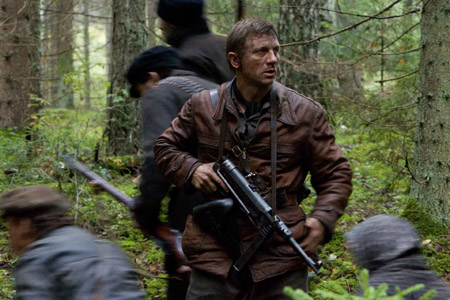
It was only a matter of time before WWII/Holocaust drama and Edward Zwick found each other. "Defiance" is the perfect little-known underdog war story that perfectly fits Zwick's ("Glory," "The Last Samurai," "Blood Diamond") tastes. Historical war drama with a heavy action slant as per usual, "Defiance" has all the elements that anyone who's enjoyed Zwick's past work is looking for: lush cinematography, gripping action and a strong leading male role played by an elite actor. At the same time, for a Holocaust story that hasn't already received the silver screen treatment (a rarity these days it seems), "Defiance" seems like it's been done before and doesn't fully extend its audience the extraordinary experience its unique premise suggest it capable of.  

For a different take on the Holocaust, "Defiance" follows the true story of a band of Jews who averted capture in Belarussia but were forced to hide out in its forests. Daniel Craig and Liev Schreiber play Tuvya and Zus Bielski, two daring, able-bodied and rather vengeful brothers who lead the group of nearly 1,000 Jews.  

The plot's most unlike other Holocaust films in that it doesn't require pity and horror from its audience in order to become emotionally attached. That attachment is not as strong compared to these other films, but in "Defiance," the Jews are largely in charge of their destiny. Craig's character has no less of a self-awarded license to kill than James Bond does when it comes to the liberties he takes killing German soldiers. At times it almost becomes tough watching Craig and Schreiber blowing Nazi brains out, and the whole revenge factor with the Holocaust is somewhat uncomfortable. 

I welcomed this feeling, but the script doesn't pray on our challenge stomaching some of its images and just lets them fizzle out before they can turn into something deep. The characters never become as troubled as we are by what they do, which really holds "Defiance" back. The neatest part of the script by Zwick and Clayton Frohman is its old testament imagery. The story of the Jewish people has sadly been about constantly escaping persecution and the way the film tries to reawaken the images of Exodus and running from the Egyptians and crossing the Red Sea really puts this film in a greater context of Jewish history. It's not about the tragedy of the Holocaust itself, it eludes to being a lot more. 

Still, there's more to be desired on this front too -- it's not exactly made integral to the story being told. There's a lot to enjoy about Zwick's film as there always is with his ability to make history adrenaline-pumping, even though the story underachieves more than many of his other films have. The action is exciting and modern without detracting from the historical context and the forest is captured beautifully on camera. If only it had been written in a way that would've gripped its audience with tender, intimate scenes revealing character instead of speeches about fighting.

3.5/5 Stars

Directed by: Edward Zwick
Written by: Clayton Frohman, Edward Zwick, Nechama Tec (book)
Starring: Daniel Craig, Liev Schreiber, Jamie Bell, Alexa Davalos

Monday, August 17, 2009

Review: The Hurt Locker - 4.5/5 Stars


Though there have been a few attempts to quickly turn over a good film about the Iraq War or a similar conflict ("The Lucky Ones," "In the Valley of Elah," "Jarhead," "The Kingdom"), none achieve on so many levels and try to capture the true experience of today's soldiers like "The Hurt Locker."

Former embedded journalist Mark Boal (who wrote the story for "Elah") captures the spirit of this particular war with his story about a team of bomb diffusers who work with IEDs (Improvised Explosive Devices). The story mainly focuses on one bomb specialist, Sgt. Will James (Jeremy Renner), who enters the picture after the team's beloved Sgt. Thompson (Guy Pearce) dies on the job. James is highly skilled, but also totes an action junkie attitude that creates tension between him and his fellow squad members.

What will unfortunately surprise a lot of people watching this film is its director, Kathryn Bigelow. If you have any doubts of a woman's ability to make a Grade A action film than throw them out the window. Bigelow, who also directed action cult favorite "Point Break" and the okay film "K-19: The Widowmaker" paves the way for women action directors with this excellent film. She sets a precedent for what today's war film should look like with the raw, camcorder style that gives "Hurt Locker" its realistic, documentary feel. Screw the awing cinematography of "Saving Private Ryan," the Iraq War is not to be glorified by the camera in any way, especially considering it's still going on.

Other war films dabble in the glory of war, the traumatic effects it has on its soldiers and its many other evils, but "Hurt Locker" dares to consider the temptations, the allure of war despite its disastrous affects. Its main character, James, is certainly troubled, but not because of seeing death or risking it every time he tries to diffuse a homemade C4 bomb -- it's because he needs the adrenaline rush of feeling like he's doing something dangerous and important.

To Bigelow, that is the defining characteristic of this war and James embodies it. He alone at times is the sole cause of action and tension in the film. We think to ourselves that he's in a dangerous situation with a bomb threat -- then he takes his protective suit off and the intensity is magnified. In that way, Bigelow plays off our own desire to see action and suspense. It would be a whole lot nicer if the guys stayed out of trouble considering they're set to be sent home in less than a month's time, but it wouldn't be exciting. James mirrors our own action fetishism in that way, and herein lies the film's true excellence.

"The Hurt Locker" is an interesting film and the first originally poignant piece of cinema to be attached to the Iraq War in a way that makes a statement that films embodying Vietnam or World War II haven't already made. It's unknown cast is talented and helps keep the film much more realistic. There's something about seeing actors that are too well known in war films that instantly glamorizes it and detracts from its impact. 

To boot, there's a lot of great suspense and action. Scenes where nothing ultimately happens put us on the edge of our seats because they're well set-up. The soldiers' paranoia among other things translates well to an audience unaware of the true dangers of the Iraq War and highlights what makes this time significant in our history compared to any other. This is the kind of movie that could be used as a means of understanding the Iraq War years and years from now, especially in terms of grasping the perspective we had before it was even over.

4.5/5 Stars

Directed by: Kathryn Bigelow
Written by: Mark Boal
Starring: Jeremy Renner, Guy Pearce, Ralph Fiennes