Showing posts with label Reviews (Archive - Drama). Show all posts

Monday, November 30, 2009

Archive Review: Shine (1996) - 4/5 Stars


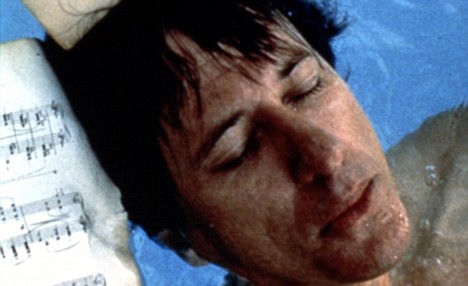
A great piece of music -- and this is especially true of works for piano -- conveys a mood or sometimes many moods; it is incredibly affective. While listening you might feel comfortable and at ease at one point and then suddenly chaotic and unsettled at another. This is certainly true of Rachmaninoff's Concerto No. 3 in D minor, the challenging piece that "Shine" main character David Helfgott aspires to master. The piece plays a pivotal role in Helfgott's story and as such, this film based on him brilliantly reflects its beauty and turbulence.

"Shine" is not a typical biopic in this way: there are no scenes written or dragged out solely to open your tear ducts. If that happens at all, it's purely incidental. The only thing that's truly reminiscent of a standard biopic is the first half of the film telling the story of Helfgott's childhood and rocky relationship with his father.

The beginning is chronological as one would expect, moving logically from scene to scene, showing Helfgott's talents and his father's refusal to let him become his own person. Armin Mueller-Stahl is excellent as the father. He manages to take what we first associate as merely stubborn, stern and demanding and make us really understand that it's not black and white. Though he beats David on two occasions, he doesn't simply become the "abusive father" you get in many biopics: he is clearly struggling with David's success and and blind to the fact that he's become possessive and is living vicariously through him. He might indeed be unfairly manipulative, but we clearly see the world view (Holocaust survivor immigrated to Australia) behind it.

When Helfgott finally escapes to London to learn at the Royal School of Music, attempts Rachmaninoff for a recital and suffers a breakdown at the conclusion of the piece, suddenly the film becomes a series of clips: scenes that appear to be in order but lack clear objective and purpose with exception of David's piano skills returning bit by bit.

This recital/Helfgott's breakdown scene is the best in the movie. It's the first act climax that takes the story out of childhood and into David's struggle to become himself again as seen through the incredible Geoffrey Rush. The Rachmaninoff starts off easy, comforting and grows in intensity. Suddenly there's great suspense to the film and we see David sweating profusely, cut-ins of his father listening to a recording and then silence and blurred camera-work. In the moment, director Scott Hicks' work here might feel over-dramatic, but as the story continues and we never fully get an explanation of what happened (such as why Helfgott needed shock treatments) it becomes emblematic of the struggle Helfgott went through.

The end feels disjointed and its pacing frantic. The expectation is that David will make this miraculous comeback and in truth he does, it's just not with the surge of a full string orchestra playing in the background -- it's with the subtlety of Liszt, Rimsky-Korsakov, Schumann or Chopin. It's a bit devoid of feeling or satisfaction but it's justified by the way Jan Sardi has "composed" the film. The story is happy being focused on the upbringing and less so with Helfgott's rehab despite Rush's Raymond Babbitt-quality performance. The lack of a cookie-cutter emotional climax and crying and hugging scenes will rub some average viewers the wrong way, but "Shine" deserves a good deal of admiration.


4/5 Stars

Directed by: Scott Hicks
Written by: Jan Sardi, Scott Hicks
Starring: Geoffrey Rush, Armin Mueller-Stahl

Thursday, November 26, 2009

Archive Review: Slaughterhouse-Five (1972) - 3/5 Stars


Kurt Vonnegut Jr's book "Slaughterhouse-Five" is a classic and the film version gets by on this fact alone. The rather faithful adaptation is enough to satisfy fans of the novel, but not even the great George Roy Hill can manage to turn Stephen Geller's uninspired script into a more meaningful movie experience.

To its credit, the film does find a handful of moments to illustrate how its main character, Billy Pilgrim (Michael Sacks), is unstuck in time. Vonnegut Jr's book is all about its fragmented and displaced structure, making the film's transitions key to visually re-creating "Slaughterhouse-Five." A number of these transitions work nicely, but mostly they feel like shifts between Billy during the war, Billy and his family life and Billy on the planet Tralfamador. They're sometimes quick and uncreative and we fail to ever fully enter Billy's shoes.

It's a shame, because Billy Pilgrim is an easy character to sympathize with. His horror stories as a prisoner of war in Germany, living through the bombing of Dresden and the unsatisfactory marriage that he's sort of participating in are emblematic of many average peoples' lives. Compound that with the idea that he experiences his life out of order, unable to put anything in the past or avoid the future and his existence is something we can't help but wonder how we would handle -- and ultimately be glad we don't have to.

Part of the problem is that Vonnegut Jr's beautiful but difficult prose is lost. Say "So it goes" at the end of a sentence and any literature lover will get your reference. The phrase doesn't so much as earn a cameo to my recollection in the entire film. Rarely does a film beg for a film-making technique like "Slaughterhouse-Five," but it's painfully obvious that it needs voice-over narration, or some kind of guiding force to help us through this structurally disjointed journey.

Hill and Geller create some nice moments that weren't notable or even included in the book, but it's all throwaway without something to tie it together, something to complicate Vonnegut Jr's themes and allude to the epiphany about time at the climax. Instead, Pilgrim's explanation of time in the final ten minutes is the crux of the entire film, the only moment that really exposes the goal of the story's chronological experiment.

Geller's adaptation is just not enough. It's satisfying and faithful, but it doesn't leave an imprint like the novel does. The screenplay doesn't match the intensity of the creative energy from Vonnegut Jr's classic, it merely attempts to mimic it in the most basic way.


3/5 Stars

Directed by: George Roy Hill
Written by: Stephen Geller, Kurt Vonnegut Jr. (novel)
Starring: Michael Sacks, Ron Liebman, Sharon Gans, Valeri Perrine

Monday, November 2, 2009

Archive Review: Glengarry Glen Ross (1992) - 4/5 Stars


If Michael, Magic and Larry, etc. became the first ever "Dream Team" of basketball players in 1992, then the cast of the "Glengarry Glen Ross" should be considered the "Dream Team" of male acting. There's Al Pacino, Jack Lemmon, Alan Arkin, Kevin Spacey, Ed Harris, Jonathan Pryce and Alec Baldwin. You won't find seven better names in an opening credit sequence.

Together they make up the all-male cast of the film adaptation of David Mamet's play and they lend it the sheer power that this exploration of human nature through the eyes of desperate salesmen might not have otherwise had.

It's no surprise director James Foley was incredible wary of taking a story that clearly belongs on the stage and turning into into a film. "Glengarry" is dialogue-driven and there's absolutely no physical action in the entire script, which takes place in less than 24 hours real time. It relies heavily on impassioned monologues and the morally ambiguous characters delivering them.

The film's first major scene features an angry speech from Baldwin meant to fire up a group of slimy, foul-mouthed real-estate salesmen, explaining that whoever finishes top in sales wins a Cadillac and the loser gets fired. Firm boss Williamson (Spacey) hands the men tired leads and they complain that without the new Glengarry leads, they won't sell a thing.

The highlight is a 66-year-old Jack Lemmon as Shelley Levene. I'm baffled at the fact that he received no Oscar nomination considering his status with the Academy. Levene is completely desperate: he works the old leads until he can't anymore, tries to bribe Williamson for Glengarry leads and Lemmon absolutely nails the obnoxious salesman who always has some cheap maneuver in his back pocket. Instead, Pacino got the nomination as Ricky Roma, the hotshot salesman with a serious attitude. He's excellent, but we've seen Pacino with that kind of command numerous times before.

"Glengarry" is a tough film, but Foley and this amazing cast sell you on it the best they can. The story leans on its characters, the talent playing them and the illustrative and attention- seizing monologues they deliver and it can lean away considering those aspects are like impervious steel. There's no way the film could be handled any better. Foley gives maximum effort to provide the most compelling angles for the dialogue, shots that will reveal as much character as possible and stimulate audience thinking. Its very open-ended themes will connect with only a chunk of its viewers, but you have to admire the absolute power that this amassing of talent commands on the screen.

4/5 Stars

Directed by: James Foley
Written by: David Mamet (play, screenplay)
Starring: Jack Lemmon, Al Pacino, Kevin Spacey

Tuesday, October 20, 2009

Archive Review: The Aviator (2004) - 4/5 Stars

Martin Scorsese's second collaboration with Leonardo DiCaprio is "The Aviator," a nearly three-hour biopic examining about a thirty-year window in the life of airline and movie mogul Howard Hughes, whose successes in aviation and Hollywood romances made him shine in the public eye despite the bankrupting methods and slowly growing obsessive compulsions that tore at his private life.

Despite the length, Scorsese uses his brilliant talents to show how compulsion began to eat away at Hughes. To be honest, Hughes' story is nothing unbelievable or inspirational. When one decides to do a biopic, it's normally because the figure is compelling in a way audiences have never seen -- but that's not Hughes. His story is not so much what he did but the manner in which he did it, so Scorsese deserves a lot of the credit for keeping "Aviator" a compelling biography.

Scorsese brings what could constitute as horror movie technique to illustrate Hughes' OCD. For one thing, OCD is not a vocal part of this film. It's never mentioned aloud except when a few characters describe Hughes as "eccentric." Scorsese is solely responsible for our understanding of Hughes' condition. The way hands are shown moving slowly and elegantly in the film, the way Scorsese holds on a close-up of red meat -- we get what's going on in Hughes' head.

The blast of light from old-time flashbulbs and the crunching of glass, the way different characters' start to speak over each other -- we easily identify with Hughes' discomfort. Some help from Robert Richardson's stunning color palettes and unusual but striking lighting effects certainly helped.

On the other side of the coin, the "continue to spend money to be ahead of the curve" slogan motivating Hughes' inventing beginning with making "Hell's Angels" the most expensive movie ever made (at the time) highlights the difference between him and ourselves. Nobody logically would have dared to do the things Hughes did, but he had the money and the drive to do it, constantly forcing his business manager (John C. Reilly, in the movie's first scene) to take care of the technicalities and to make it work regardless of what it took. The fact that Hughes kept going despite OCD and making debilitating choices is what makes him a great biographical figure.

Parts of "Aviator," while a big part of his life, don't seem to add to this core vision Scorsese and writer John Logan ("Gladiator," "The Last Samurai") paints of who Hughes was. His playboy persona adds another mysterious dimension to his character, but as great as Cate Blanchett (Katherine Hepburn) and Kate Beckinsale (Ava Gardner) are in this film, their subplots don't fit as well considering how much else is going on. In summary, Hughes needed them as maternal figures in a way, but couldn't offer them anything substantial as far as love and affection. As interesting as that is to note, notice that it doesn't exactly influence Hughes' ceaseless drive to make the best planes in the world.

As Alan Alda's character Sen. Brewster enters the picture and attacks the image of Hughes that we grew accustomed to in the first chunk of the film, calling him a criminal for using military tax dollars and never having anything to show for it, we start to see Hughes' legacy. One could call Hughes a number of things, but not a liar or a crook. His flaws were in his ambition, not his core self. In 170 minutes he never once smokes a cigarette or drinks liquor -- you won't find that from a protagonist in a 1920-1947 period biopic in any other film. Coincidentally, the ambition of this film to fire off that message for its entire duration is its only real fault.

4/5 Stars

Directed by: Martyin Scorsese
Written by: John Logan
Starring: Leonardo DiCaprio, Cate Blanchett, John C. Reilly, Kate Beckinsale, Alan Alda, Alec Baldwin

Saturday, October 10, 2009

Archive Review: Midnight Cowboy (1969) - 4/5 Stars

Forty years later, it's much harder to call John Schlesinger's film "Midnight Cowboy" avant- garde, but the greatest X-rated film of all time is as much a reflection of the '60s as it is a study of unusual and pitiable characters.

Joe Buck (Jon Voight) is a cowboy by attitude, hustler by trade who travels to New York City in hopes of making a killing on the massive numbers of sexually frustrated urban married women. Unfortunately, Joe is not only naive, but all kinds of stupid and he's haunted by a difficult past that comes to us in trippy flashbacks edited like a classic horror film. In the city he meets Rizzo (Dustin Hoffman), a scummy pickpocket with a bum leg who offers to be his "manager."

The sexuality of the film is nothing surprising to the modern viewer, but for 1969 it's conceivable that it was. The original tagline was "Whatever you hear about "Midnight Cowboy" is true." That gives you a sense of what it was perceived as upon its release. Prostitution is a constant (although nudity not as gratuitous as one might expect), homosexuality is suggested on more than a couple occasions and the sexual liberation of women is acknowledged. That's a lot for that era, which combined with Woodstock makes '69 the beginning of a new one.

Look behind the shocking social issues in "Midnight Cowboy," however, and there's a much simpler quality story that most film-lovers watching today will tap into. Religious fanatic Mr. O'Daniel (John McGiver) gets it out early when he questions Joe about his loneliness. From then on, despite the conscious objectives of the film and its characters to try and make a living and survive in a downtrodden NYC, "Midnight Cowboy" is about all the characters having the satisfaction of companionship in every sense and on every level.

Very little positive happens to Joe because of his lack of street smarts. He keeps getting screwed over or taken advantage of by everyone in the city until Rizzo changes his mind and the two look out for each other. The way these two handle their adversity is the most interesting part and what really allowed Voight and Hoffman to earn their Oscar nominations.

Another way the film stands out as groundbreaking is through Schlesinger's direction. Although we're left wanting more definitive answers and insights regarding Joe's bad dreams and flashbacks about his past, they're still edited in a way that makes them critical to the story. We're able to draw our own understanding from how the past and present are stitched together, able to like or be interested in Joe because this abrupt style communicates the psychological impact it has on him.

"Midnight Cowboy" isn't a cathartic story, but more a simple one shrouded in social issues and more radical film-making decades ahead of its time. The way it's best appreciated now is in that light, not in the way it pushed our boundaries and took a bite out of censorship back in its day, but in the fundamental and universal message it comes to and instills in its audience about loneliness by way of unique characters that many of us might find morally questionable.

4/5 Stars

Directed by: John Schelsinger
Written by: Waldo Salt, James Leo Herlihy (novel)
Starring: John Voight, Dustin Hoffman

Wednesday, September 30, 2009

Archive Review: Dead Poets Society (1989) - 5/5 Stars

"Dead Poets Society" is a maturing into adulthood drama whose story and messages are as instructional as they are inspiring. The film is like an inspirational teacher, the one in high school that changed the way you thought about life and knowledge. It reflects this in Mr. Keating, the teacher who touched the lives of a group of teenage boys for the better despite the monstrous obstacle of conformity in all their paths.

Directed by Peter Weir ("Gallipoli") and written beautifully by Tom Schulman, "Dead Poets Society" stars Robin Williams in one his first great dramatic performances as Keating, an English teacher at an all-boys boarding school who inspires his students with poetry and by encourages their own free thinking with the simple motto of "carpe diem (seize the day)."

But the film is really about the boys and their various struggles. Todd (Ethan Hawke) is quiet and keeps to himself -- he's scared of personal expression. Neil (Robert Sean Leonard) is living in the iron grip of his father (Kurtwood Smith) who insists he become a doctor when his passion is really acting. Knox (Josh Charles) discovers infatuation/love and the courage it requires and Charlie deals the barriers of free speech. Keating's lessons inspire their actions and bring out new parts of themselves and together they hold Dead Poets Society meetings in a cave in the woods.

The clique of rebellious teenage boys and their unusual teacher are not motifs foreign to film, and neither are themes of fighting conformity and making the most of life. Most adults know all about these ideas -- they're not exactly profound and original -- but Tom Schulman tells "Dead Poets Society" in such a way that allows you to rediscover them and reawaken memories of what that personal experience was like. We see the rigid culture and system of the school and the classroom and then suddenly Keating comes in and makes learning what it should be. Suddenly we remember who our "Keatings" were and what it was like when we finally learned the value of our own perspectives, ideas and most importantly, desires.

The cast of young men is excellent. They make sure no character entirely falls into a teenage stereotype despite their many personalities that make up the group dynamic. We remember our own youthful enthusiasm through their experience and empathize with their troubles.

Weir's direction leads us gracefully into this rediscovery. His use of symbolism and the subtle ways he re-implants elements of the classroom scenes into the students' subplots and other key moments of the film draw us back to the power of the learning experience and how it can leave such a fine imprint on our lives. We see clearly how those scenes with Keating give life to the rest of the story and rekindle our memories and ignite our emotions as we connect to the characters and their experiences.

"Dead Poets Society" is a great execution of a simple inspirational drama/tragedy. Despite having all the elements, it avoids cliché much of the time or at least masks it with the strong connection the story builds with its audience. Many films have been more dramatic or original, but this film really gets the most out of what it is and tells a story about something universally human to which every soul with even the slightest meaningful education experience can relate.

5/5 Stars

Directed By: Peter Weir
Written by: Tom Schulman
Starring: Robin Williams, Robert Sean Leonard, Ethan Hawke

Monday, September 7, 2009

Archive Review: The Elephant Man (1980) - 5/5 Stars


"Looks are deceiving" would be an adequate way to describe the "The Elephant Man" as a film from the outside, but it would be a horribly amateur way to describe its message. David Lynch's film soars beyond mere pity for those with life-altering physical abnormalities and serves as more than just a slap on the wrist to a generally unsympathetic public. It is a study of the human condition and Lynch's camera a microscope examining one of its most fragile examples.

Taking place in Victorian London and filmed like a classic '30s or '40s film in black and white, "The Elephant Man" carries that classic naive sensibility that combined with the hideous deformities of its central character, creates a bit of horror and suspense before it appeals to our better nature by eliciting sympathy and understanding.

John Merrick (John Hurt) is "The Elephant Man" to the abusive owner exploiting him in a freak show, but when Frederick Treves (Anthony Hopkins), a doctor studying anatomy, finds him and sees him for the first time, a tear runs down Hopkins' face in a powerful close-up and the doctor brings him to hospital, nursing him to health and soon socializing him.

It's a fascinating story. For the first half hour we're hooked by sheer curiosity over what John looks like and how he came to be, a technique that catches one of our most unflattering flaws in that we gape at the unknown and the abnormal. It then shows us more and more of John, slowly unveiling his humanity, and suddenly we're converted and incredibly protective of this unusual character.

The film provides an array of human reactions to seeing/meeting someone so terribly disfigured. Treves' wife, for example, cries uncontrollably out of pity, a famous actress treats him like a fascinating human being, a nurse screams at the sight of him and sadly many exploit him. This broad spectrum fully puts you in John's shoes and leaves you with incredible insight into his unique situation.

As a filmmaker, Lynch leads us quite easily to our own discoveries about what John's story teaches us. He nudges us toward symbolism without beating us with it and cuts away from scenes just as we react to them instead of giving moments of pause and total resolution. This creates a totally different reaction to what happens in a scene. It's raw, unresolved, maybe even troubling -- but it works and we manage to understand the significance better because he pulls us away at a moment of tension.

There are some abstract techniques and shots bookending the film in short scenes with John's mother, but little else is cryptic. Lynch really draws out the similarities and differences between John as an uncared for circus attraction and John as the fascinating man everyone wants to meet, which is the heart of both our and Treves' moral dilemma. Then, as John runs away from a mob at a London train station, we get that simple but powerful line: "I am not an animal! I am a human being! I ... am ... a man!" and suddenly it all clicks. Now that's fantastic film-making. 

5/5 Stars

Directed by: David Lynch
Written by: Christopher De Vore, Eric Bergren, David Lynch, Sir Frederick Treves and Ashley Montagu (books)
Starring: Anthony Hopkins, John Hurt

Friday, September 4, 2009

Archive Review: Gran Torino (2008) - 3.5/5 Stars


"Gran Torino" has to be the only good politically incorrect film to ever be made. Clint Eastwood's character Walt Kowalski is a crotchety and ignorant old Korean War vet whose vocabulary is a thesaurus of racial slurs. He's basically a racist Dirty Harry in his 70s-80s and the script hits us over the head with his unabashed insensitivity and cold-heartedness to the point where "Gran Torino" is half comedy. But then, as only a masterful director such as Eastwood can do, "Gran Torino" becomes one of those classic unlikely relationship films between a widower and his teenage Asian-American neighbor. It's a film with a great premise but an off-kilter script that Eastwood salvages into something poetic.

There's no question Eastwood liked the potential he saw in rookie writers Nick Schenk and David Johannson's script for himself as an actor and a director. It is the perfect cap to his illustrious acting career, combining his great character acting in westerns and the Dirty Harry movies with his more dramatic pictures of the last 15 or so years. It's an unrefined story, but contains a lot of great storytelling potential.

Taking place in an old Michigan neighborhood that has since become overrun with Hmong (Southeast Asian) immigrants, "Gran Torino" is about the widower Walt and the teenage Hmong boy next door, an introvert who is peer pressured to join his cousin's gang. When the boy, Thao, tries to steal Walt's 1972 Gran Torino and Walt unintentionally saves Thao from gang trouble, Walt, Thao and Thao's family become entangled, more so than Walt would like.

Walt sort of mentors Thao in an inappropriate and grouchy way and he boldly confronts various gangs posing dangers to Thao and his sister Sue despite doing something each time to counter his act of "kindness" with a demeaning or ignorant comment. The script meddles with stereotypes a bit too much in this way, trying to use other characters' dialogue to battle the extremism of Eastwood's character. Sue, for example, gets hit on in one scene by three black guys who trash her white friend who calls them "bros" and to defend herself she starts calling them out on their stereotypical "pick on the Asian girl" behavior. Basically, "Gran Torino" gets a bit in over its head in trying to present an accurate racial palette.

At the same time, diversity themes are part of the film's strength. No major film has focused on Hmong Americans before, and considering the prejudices Walt brings with him from the Korean War, they're an ideal focus for the story. The major differences between Walt's lifestyle and theirs is part of what keeps "Gran Torino" interesting.

There's no question that Eastwood know what he's doing. He has an uncanny ability to keep the audience guessing what's coming but the story never goes where you expect it to. It's both engaging and surprising and his techniques speak as much truth if not more than the script.

The only other thing hurting "Gran Torino" is its lack of an experienced supporting cast. Although Hmong actors needed to play Hmong characters, Walt's sons and the Catholic priest that pesters Walt to confess his sins are weak. Eastwood dominates the scenes he's in and if he's not in a scene, the film lacks power and authenticity. Walt might be a flagrant hater of all peoples not white and American, but he's at least convincingly so where the other actors aren't.

So despite its twisted and questionably inadvertent sense of humor, "Gran Torino" is a triumph of veteran film-making and a dominating lead actor over amateur storytelling and a weak overall cast. The film takes refuge in its quiet but lovable teenage protagonist and the relationship he develops with a foul-mouthed old man and how both help each other in the end. We expect Walt to turn into a softie when he takes Thao under his wing, but he never caves completely, and that's admirable, even if it would be nice for him to take a break from the pejorative comments so that the laughs would be a bit more guilt-free.

3.5/5 Stars

"Gran Torino" (2008)
Directed by: Clint Eastwood
Written by: Nick Schenk, David Johannson
Starring: Clint Eastwood, Bee Vang, Christopher Carley

Monday, August 31, 2009

Archive Review: Billy Elliot (2000) - 4.5/5 Stars


Dancing, passion and familial struggle are all tied together in the high-spirited "Billy Elliot," the little independent film that could in 2000, when such films were drastically under- appreciated. "Billy Elliot" caught some attention however because it combines the dream-like fancy-free spirit of Fred Astaire and Ginger Rogers films along with the social-historical context of the '80s coal miner strike in England. Youthful optimism and social reality are at odds as seen through the young Billy (a very talented Jamie Bell) and the film doesn't let either one completely win out, an admirable and unexpected quality for a story about a child.

Pre-teen Billy lives in a small England town where his father (Gary Lewis) and brother (Jamie Draven) are picketing as part of the coal miner's strike, so money is scarce. His father then becomes especially angry to find out Billy's been taking the money he was supposed to be using to pay for boxing lessons for ballet instruction instead. Despite his father's disapproval at his son taking up a "girl's" activity, Billy meets regularly with Mrs. Wilkinson (Julie Walters) to prepare for the Royal Ballet School audition.

The feature film debut for both writer Lee Hall and director Stephen Daldry, "Billy Elliot" is a real triumph of art imitating life. In a stroke of inspired creativity, Billy dances when he feels it, when he needs to express emotions of anger or excitement or when he was something to prove. Scenes are intercut often to show how Billy's drive to master ballet is indicative of a need for self-discovery, family approval and learning how to handle life's challenges.

With a soundtrack mixing '70s English rock band T-Rex with classical music and orchestration by 1999 Oscar-winning composer Stephen Warbeck, "Billy Elliot" takes on this true independent spirit. It's far from the cheesy uplifting string music of an inspirational drama and more true to its historical context. Its much easier to sympathize with Billy's yearning for movement and his description of "electricity" in terms of how dance makes him feel with modern music.

Billy's dancing outburst scenes give the film the feel of a dance musical movie ala the Fred Astaire era of Hollywood, while his angry and emotionally withdrawn father as well as Billy's own fits of irrational anger ground the movie in the struggles that surround the Elliot family on a daily basis. 

The film is also not a social commentary on gender roles despite the conflict of Billy wanting to dance and his father wanting him to box. Billy takes an unexplained interest in dancing and doesn't exhibit any "homosexual" tendencies. This is about doing something you're passionate about, not a child's struggle with his gender identity. Billy's cross-dressing friend is there to remind us that one thing is not connected to the other, but the film doesn't waste time overdramatizing this small conflict in a greater story.

"Billy Elliot" is a special film, one that perfectly fits the magic of finding one's passion within the troubles of real life and a cast that accurately reflects that vision from Daldry and Hall. It acknowledges that with good comes bad and with reward and hard work comes nervousness and discomfort. It's a unique outlook for a movie based about a young boy and his dreams.

4.5/5 Stars

Directed by: Stephen Daldry
Written by: Lee Hall
Starring: Jamie Bell, Julie Walters, Gary Lewis

Saturday, August 22, 2009

Archive Review: Rain Man (1988) - 4/5 Stars


"Rain Man" might be most remembered for Dustin Hoffman's brave and remarkable performance as autistic savant Raymond Babbitt, but the film's greatest strength lies elsewhere: its sense of humor. At first, you're inclined not to laugh at Raymond's oddities and especially not at the way his brother Charlie (Tom Cruise) treats him, but as the film progresses, you become less worried about being respectful and suddenly "Rain Man" is really just a film about two brothers on the road together, sometimes sharing funny moments, sometimes sharing tough ones -- but who discover something about themselves through their newfound relationship.

"Diner " director Barry Levinson, who has always carried his sense of humor about him in all his projects, is responsible for much of this tone to what is a challenging story. Ronald Bass and Barry Morrow do write in some humor, but when summarized, this film does not have a pleasant story line. It's about a young man who's angry that his father left him nothing upon his death, finds out it all went to an autistic brother he never knew he had and in his rage, as sort of a ransom, kidnaps his brother and heads for L.A. 

Cruise plays an unlikable yuppie with no patience or sympathy for his brother's condition. He's entirely selfish and blinded by deep-seated father issues having grown up without a mother and leaving his father after a dispute at age 16. It's a good role for Cruise, having played rebellious younger characters in "Top Gun" and "Risky Business" at this point in his career, it was a good fit that smoothly transitioned him into a more dramatic role, establishing him as more than just the latest fashion. 

Charlie's change is the most significant in the film, and though it's hard to believe he's not being selfish about Ray from beginning to end, it's the transformation in his sense of humor that really sells us. At first he's funny because of how he overreacts to his frustrations in taking care of Ray, but once he understands him, it becomes sweet and genial.

Raymond is Hoffman at his finest, maybe the height of his career after "Kramer vs. Kramer" and "Tootsie." Playing the mentally challenged is done so little because it's such a difficult thing and a touchy subject that Hoffman had to have handled with incredible sensitivity as he was developing the character. The real genius in his acting is in his eyes. You can always tell he's counting or paying attention to details and he's mesmerized by the world around him. That sort of guides how he interacts with the characters. Levinson picks up on this and subsequently gets a lot of scenic footage, namely Las Vegas where Raymond is fascinated by everything that sparkles.

The troublesome part of the story is that it glamorizes Ray's savant abilities and at one point takes advantage of them with little remorse. At the same time, it's clear that despite the opportunities for "Rain Man" to just lay on the sap, Levinson wants it to feel real. Even Hans Zimmer (in his first score) was forced to keep the score electronic '80s style, which while awful is a distinct choice in tone.

In real life, Charlie probably wouldn't treat his brother all that much better, he would just appreciate him differently. This is not about changing one's life forever, its about the experience and rewards of brotherhood. All the way to the ending, there's not but a brief moment that would make you want to cry, just be happy that the characters both got something positive out of the experience.


4/5 Stars

Directed by: Barry Levinson
Written by: Barry Morrow, Ronald Bass
Starring: Tom Cruise, Dustin Hoffman

Wednesday, August 19, 2009

Archive Review: Synecdoche, New York (2008) - 4/5 Stars


If you're familiar with Charlie Kaufman's work, then you understand that "Synecdoche, New York" is going to tell a story that's abstract, that feels normal but is completely out of the ordinary, and rarely feels like it's making sense. Now that he's directing his own film this time, Kaufman, the brilliant but challenging writer behind "Being John Malkovich" and "Adaptation," has creative control to create yet another layer of bizarre, making this film even harder to understand in one sitting. 

The truth is that "Synecdoche" is a fascinating movie for the small (and ever-shrinking) club of people who like watching movies they don't understand so that they can try and understand them. Anyone who tries hard enough can begin to break down the ideas generating this story, but it's not a film for the passive viewer who wants a traditional story told in a conventional way.

The film is about the life of Caden Cotard (Hoffman), an apparently ill middle-aged director who is married and has a six-year-old child that leave him. Feeling lonely and believing he's dying, he receives a grant to work on a play and giant warehouse to stage it in, and he decides he is going to create something that will attempt to make sense of life, namely his, as well as love and death. The combination of his own delusions and the absurdity of that feat -- to create the ultimate work of art accurately reflecting life -- is a good portion of what makes this film so unfathomable yet so fascinating.

Left emotionally blindsided by his wife (Catherine Keener), Caden is surrounded by the temptations of the other women he works with (there's not but one male supporting actor) such as the box office secretary who has always loved him (Samantha Morton) and the star of his last production (Michelle Williams), Caden can't make sense of his feelings and uses his art to do it. He does so for years upon years, time jumping forward at strange intervals, revealing more of who Caden really is.

Kaufman is all about the visual manifestation of thoughts and ideas, which make his film so abstract. As a director, he does a very nice job of making the film seem like it happens in a natural way despite its absurdities. His scenes are very short and move quickly and there's no map guiding you or leash to pull you along. It's frustrating and deprives you of ever having a truly deep and satisfactory "aha" moment, but it also gives you free reign to take from it what you will, even if some parts left you dumbstruck.

"Synecdoche" is a film about the life of a man trying to make a play of his life of him making a play of his life -- to give you a sense of what you're up against watching this film. In that way it is both astute and ultimately meaningless, but unquestionably heartfelt and honest. Kaufman doesn't do this to win creativity points, he does it to find unique ways of exploring and understanding the traditional themes of love and mortality in the hopes of coming across something truly profound. It's exactly what Caden tries to do. Making complete sense of life is futile, but making a concerted effort is art.

4/5 Stars

Directed by: Charlie Kaufman
Written by: Charlie Kaufman
Starring: Philip Seymour Hoffman, Catherine Keener, Samantha Morton, Michelle Williams